Revisiting the Κυκεών

Our research on the pharmacological plausibility of the κυκεών (kykeon)—the ritual drink of the Eleusinian Mysteries—has just been published in Scientific Reports, part of the Nature Portfolio.

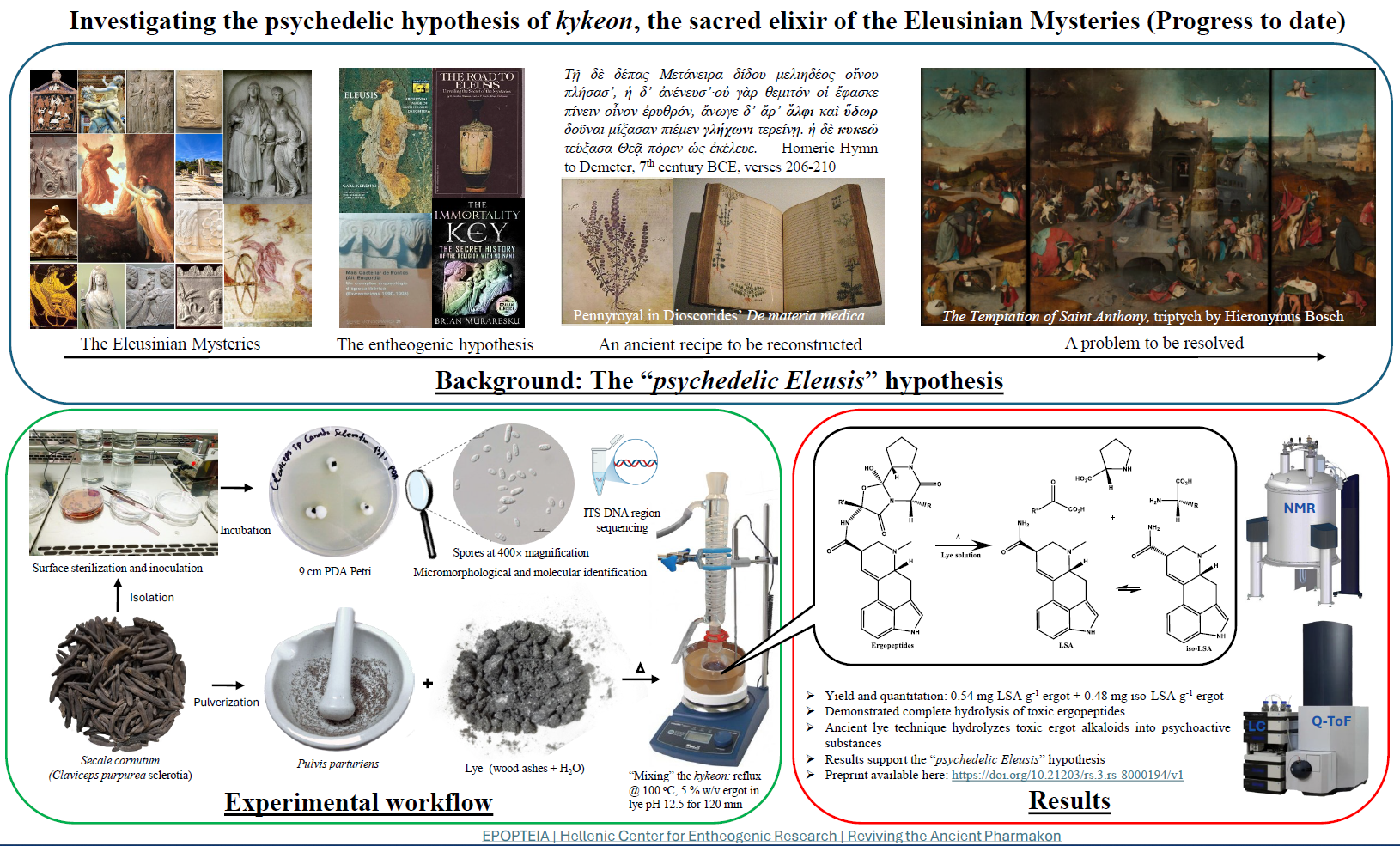
For our team, this publication marks a meaningful milestone. It brings into the open several years of work that began not as a funded initiative, but as a question raised during internal laboratory meetings in Athens in 2021. The question was simple and technical: if the kykeon had contained bioactive compounds, what would they have been? And under what ecological and chemical conditions could they have existed in ancient Attica?

The Eleusinian Mysteries were active for nearly two thousand years. Initiates traveled from across the Greek world to participate in a ritual sequence that included fasting, purification, procession, and entry into the Telesterion. Ancient testimonies describe the experience as deeply affecting, yet the central ritual substance—kykeon—is described only briefly as a mixture of barley and mint.

In the twentieth century, scholars including R. Gordon Wasson, Albert Hofmann, and Carl Ruck proposed that the kykeon may have contained ergot alkaloids derived from fungi infecting cereal grains. Ruck’s work, especially in The Road to Eleusis (1978), placed the hypothesis within serious classical and philological scholarship. The proposal has remained controversial, but it has never been systematically examined through modern pharmacological modeling.

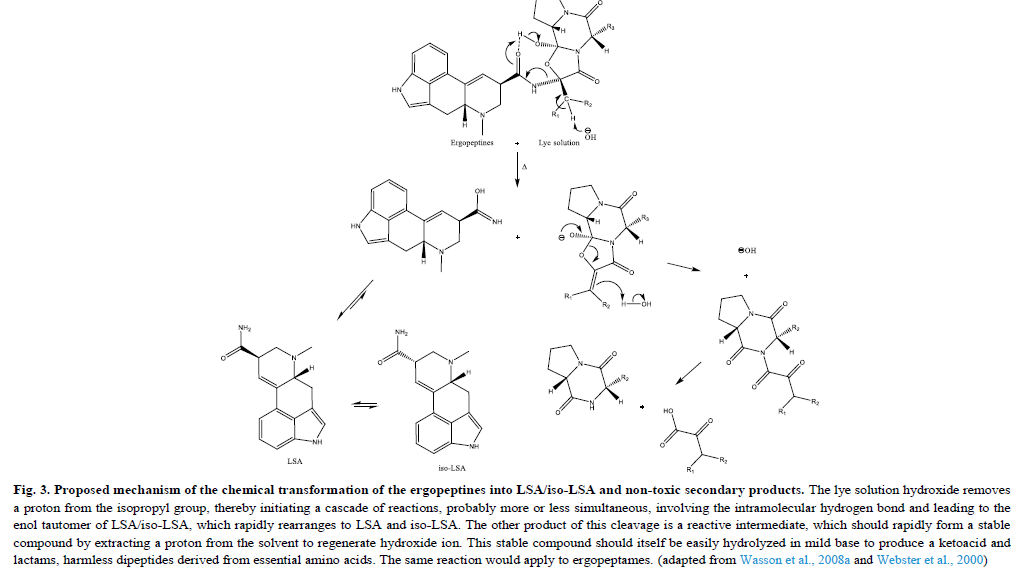
Our study approaches the question through laboratory plausibility. Under alkaline conditions, can ergot alkaloids be transformed into compounds relevant to the kykeon hypothesis?

Study Design:

To investigate this, we worked with identified ergot sclerotia (the hardened fungal structures that grow on infected grains). We subjected samples to controlled preparation methods using an alkaline solution (lye) under reflux conditions. Water controls were included for comparison. After preparation, compounds were extracted using liquid–liquid extraction techniques. The resulting samples were analyzed using:

  • ¹H-NMR (proton nuclear magnetic resonance spectroscopy)

  • UHPLC/Q-TOF-HRMS (ultra-high-performance liquid chromatography coupled with high-resolution mass spectrometry)

These methods allow precise identification and quantification of chemical structures. The ¹H-NMR spectra revealed a disappearance of signals associated with toxic ergopeptides in the alkaline-treated samples. At the same time, new signals appeared corresponding to:

  • Lysergic acid amide (LSA / ergine)

  • Isolysergic acid amide (iso-LSA)

Quantitative analysis using UHPLC/Q-TOF-HRMS supported this transformation. Under the tested alkaline conditions (120 minutes), yields reached:

  • 0.54 mg of LSA per gram of ergot

  • 0.48 mg of iso-LSA per gram of ergot

These findings demonstrate that alkaline processing can chemically convert ergot alkaloids into LSA and iso-LSA while reducing detectable toxic ergopeptides under the conditions tested. The study does not claim proof that kykeon was psychedelic, however it does establish is that certain configurations are chemically feasible under defined conditions. The entheogenic hypothesis remains open, but now framed within pharmacological parameters rather than speculation alone.

For us, this research is about examining Greece’s ritual and medical history through the tools of contemporary science.

Ancient Greek thought produced systematic natural philosophy, botanical classification, and early medical treatises. Dioscorides’ De Materia Medica catalogued hundreds of substances and laid foundations for pharmacology that endured for centuries. The Greek term pharmakon encompassed remedy, poison, and transformative agent within a single conceptual field.

Revisiting Eleusis through pharmacognosy situates the kykeon question within that broader lineage of disciplined inquiry.

This publication represents one stage in an ongoing research program. Our next steps include receptor affinity characterization of LSA and iso-LSA compounds, followed by toxicological, behavioral, and pharmacokinetic preclinical studies in collaboration with Isis Rita Anzel Koutrouli at the Psychedelic Research Center, National Institute of Mental Health (Czech Republic). These studies aim to clarify safety thresholds and central nervous system activity under controlled experimental conditions.

Much of this work has been conducted on a voluntary basis. Limited funding restricts laboratory time, compound analysis, and preclinical modeling. With additional support, we aim to expand systematic study of ancient Greek literary references to pharmaka and evaluate them alongside modern chemical and pharmacological frameworks.

The kykeon question remains open. What has changed is the framework through which it is being asked.

The full publication can be accessed here:
https://www.nature.com/articles/s41598-026-39568-3

If you are interested in supporting or collaborating on future research, you may contact us at info@epopteiacenter.org (ATTN: Eleana Baskouta)